Five Years and 300 Dives with the Tudor Pelagos
2026-06-25
The clasp failed at 18 meters, halfway through the second reef pass. I was watching a hawksbill turtle nudge a sea fan when I felt the titanium bracelet slip off my wrist and watched it tumble in slow motion toward a brain coral forty feet below. I caught it with two fingers before it settled, but the moment cost me a decompression stop I hadn't planned for. That was three years ago. The watch never came off for diving again.
What It's Not
I own a Patek Philippe. It measures 38.5 mm, fits under a shirt cuff, and tells me more about my father than about time. I wear it to dinner, to the Aman, to moments that matter. The Tudor is none of those things. It is 42 mm of matte titanium, entirely unadorned, and I wore it to change an impeller on Serenity's generator two days ago. That is what it's for.
Model: Tudor Pelagos M25600TN (first generation, in-house movement) Purchased: New, 2019 Dives: 312 logged with this watch Service: One (2023, unidirectional bezel grew stiff after 280 dives) Battery: Never — it's an automatic. Power reserve 70 hours.I wanted the opposite of what a watch collector wants. A watch that disappears.
I bought it because I wanted a watch I wouldn't think about. No polishing, no "patina," no investment value. A watch that disappears. Three hundred dives later, it has.
The Scars
It has survived salt, sand, hydraulic fluid, and a minor fire. The titanium case shows every scratch — not the way steel does, in bright lines, but as a dull scrape that seems to sink into the metal. The bezel insert is ceramic and unmarked, but the bezel edge itself is chewed along one quadrant where I scraped it against a lava tube in the Galápagos. The crystal is sapphire; it has one chip at 4 o'clock that I never bothered to fix. The helium escape valve has never been used, because I don't do saturation diving, but it has, on two occasions, leaked when I forgot to screw it down. I learned to check it with a fingernail before every descent.
Dove the outer reef at 06:15. Water temp 29°C, visibility 40+ meters. Current running east at 1.5 knots. Watch kept perfect time through the drift, 42 minutes bottom time. Max depth 29 meters. No deco obligation. The lume is fading after seven years — still legible, but not as nuclear-bright as it was.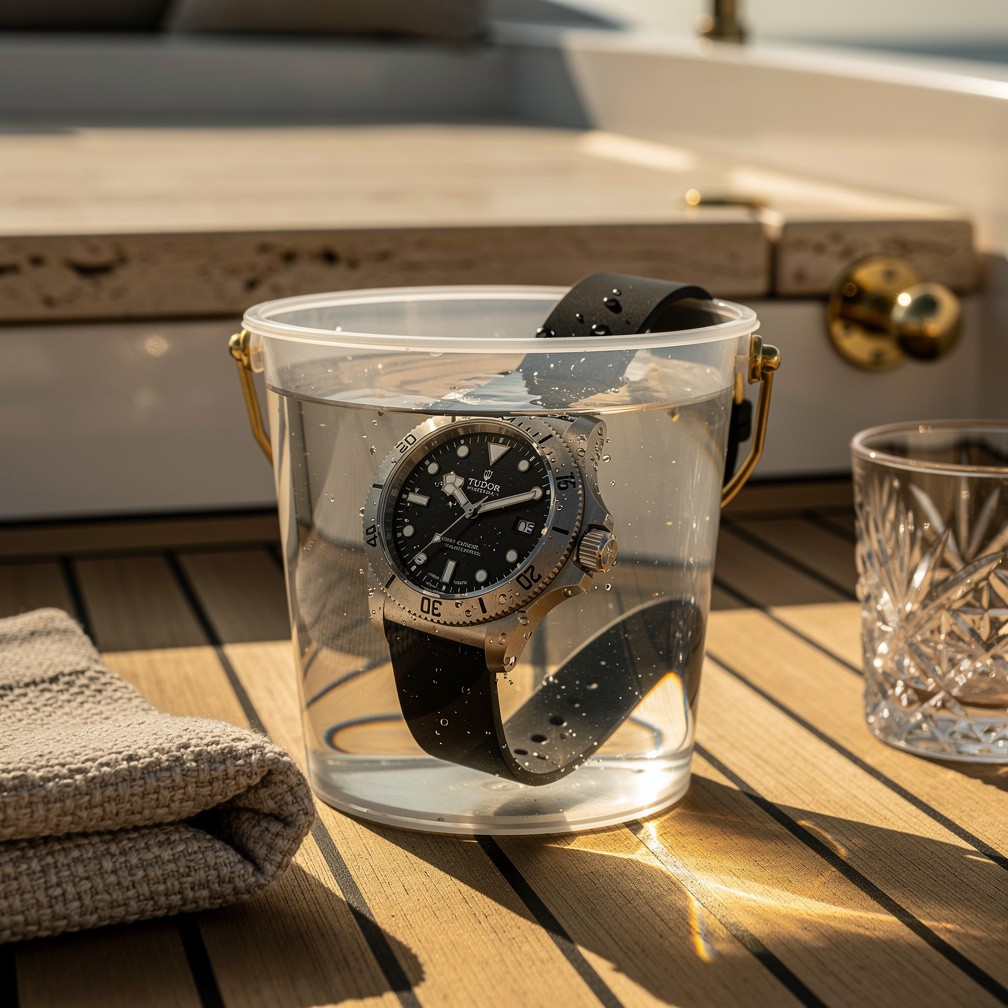
What breaks a dive watch is rarely the pressure. It's the corrosion, the dissolved salt that works into the threads of the crown and the pushers and eats the seals. The Pelagos has a titanium case and a steel caseback, and that galvanic pair should, in theory, be a problem. It hasn't been. I rinse it in fresh water after every saltwater dive — thirty seconds, nothing elaborate — and the only corrosion I've found was on a spring bar I replaced.
The Verdict
What it does is work. Accurate within COSC spec, winds while I sleep, readable at 30 meters without a light.
If I were starting over, I wouldn't buy an Omega Seamaster — prettier, but worse in the dark. I wouldn't buy a Rolex Submariner — lovely, but invites questions on a dive boat. I'd buy another Pelagos. Probably the same generation, now discontinued but findable.
It's the most honest tool I've ever strapped to my wrist.
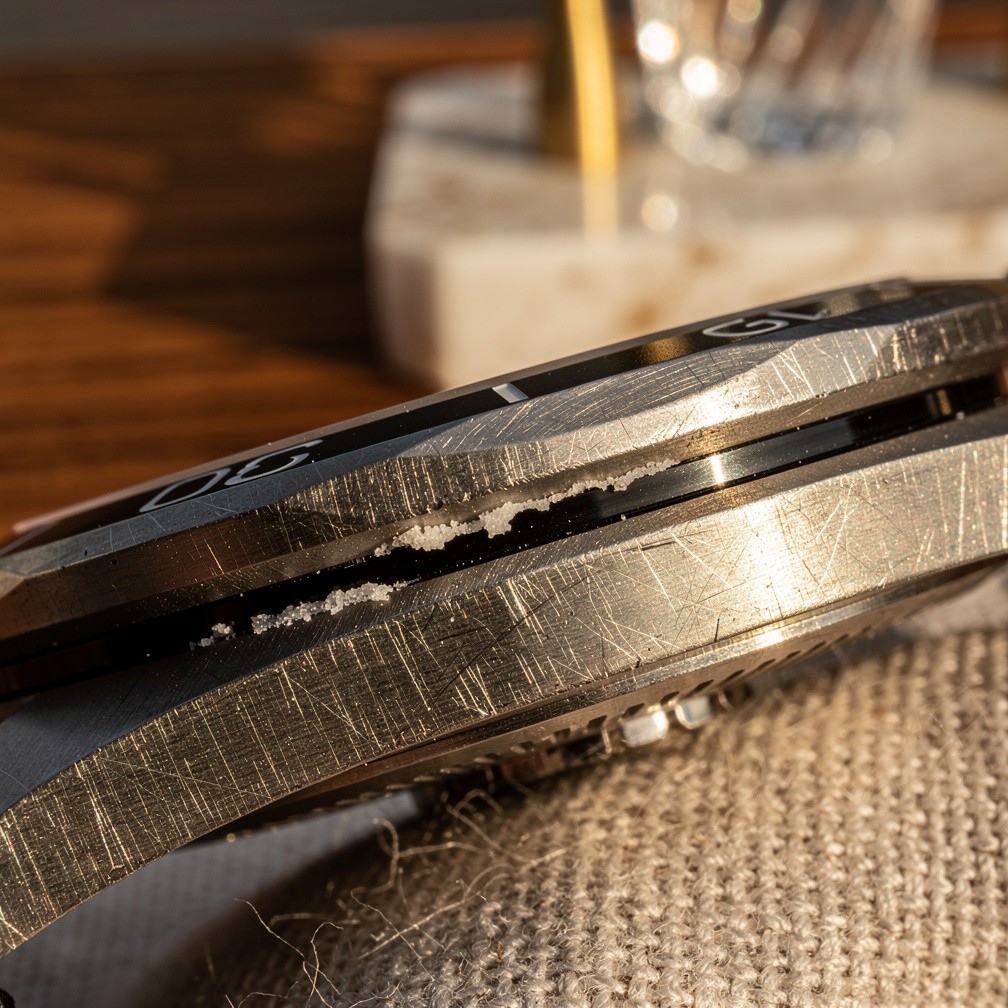
The Pelagos sits on a shelf in Serenity's saloon now, next to a depth gauge and a dive knife. It's on a rubber strap because I broke the titanium bracelet's clasp that day at 18 meters and never had it fixed. It suits me better that way. A broken clasp, a chipped crystal, a faded bezel. I look at it sometimes and think about what it would take to destroy it. I haven't found it yet.